

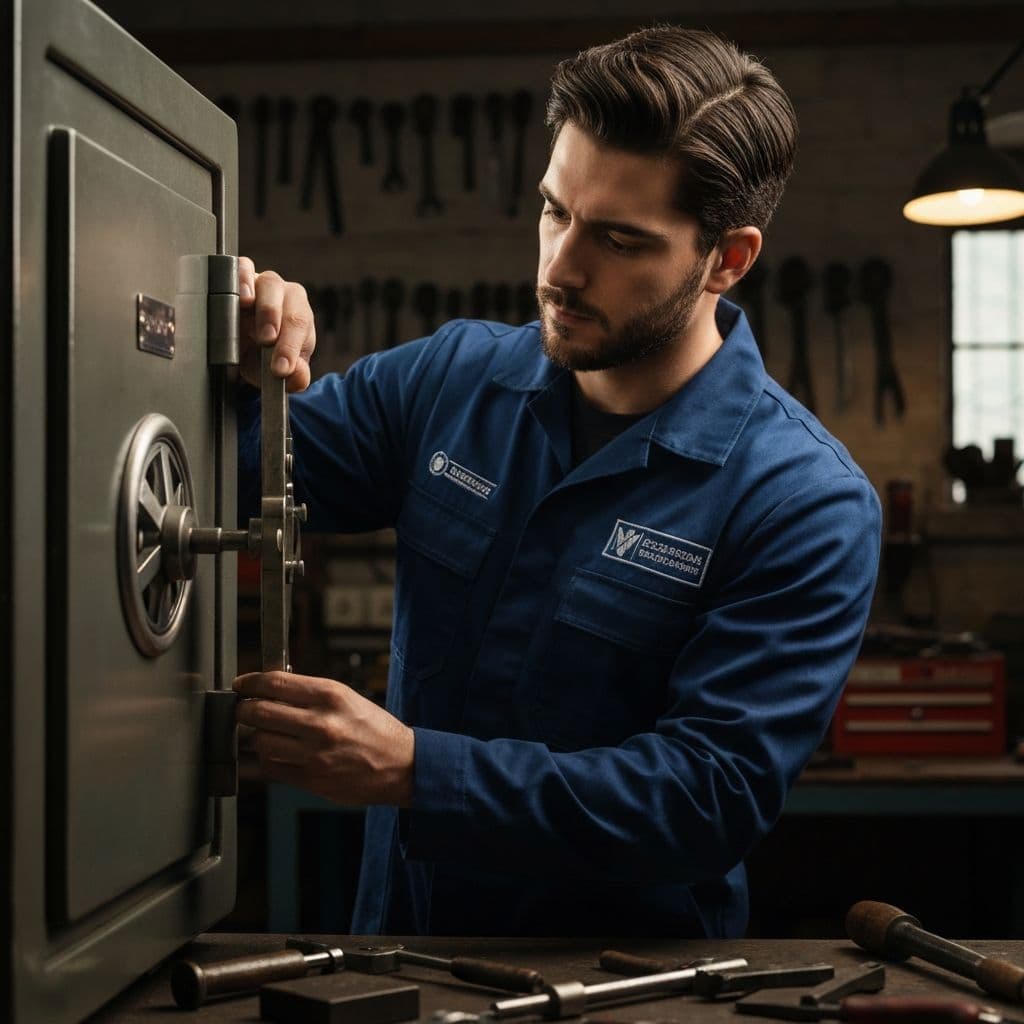
Key takeaways
- Most sudden safe lockouts are electronic, not mechanical — a dead battery pack is the single most common cause.
- Never pry, drill, or attack the hinges yourself; you can convert a ten-minute service call into a destroyed safe.
- A locksmith opens most residential safes without damaging the container or its fire rating.
- Miami humidity and salt air are hard on safe electronics and on the boltwork of units stored in garages.
- Keep the model number, and store the override key somewhere that is not inside the safe.
Why safes stop opening
Nearly every sudden safe lockout traces back to one of four things: dead batteries, a failed keypad or solenoid, a mechanical fault in the boltwork, or a combination that was never quite right to begin with.
The useful thing about that list is how lopsided it is. Electronics fail far more often than steel does, and electronics are the cheapest part to deal with. A safe that worked yesterday and refuses today is far more likely to have a power problem than a broken lock.
Only 1 of those 4 causes usually calls for opening the safe destructively — and it is the rarest of the four.
- Dead or dying batteries — the keypad lights up weakly, beeps oddly, or does nothing at all.
- Failed keypad or solenoid — the code is accepted but nothing moves inside the door.
- Boltwork fault — the handle turns freely, or jams partway, and the door stays shut.
- Wrong or drifted combination — common on dial safes that have been knocked or serviced.
Start with the batteries — properly
Before anything else, replace the batteries with a fresh, name-brand set, and hold the keypad's power or clear button for several seconds afterwards so the lock re-initialises.
This sounds too simple to be the answer, and it is the answer more often than any other single step. The trap is a half-measure: people swap in whatever batteries are in the drawer, get the same behaviour, and conclude the lock is dead.
If your safe has an override key, this is what it is for. Keep it somewhere sensible — a drawer in another room, a relative's house, anywhere that is not inside the safe it opens.
What a locksmith actually does on a safe call
The goal on every safe job is to open it without damaging the container, and most residential safes are opened non-destructively — through the lock, not through the steel.
We will not publish the techniques, for the obvious reason. What is worth knowing as an owner is the order of escalation: diagnose the electronics, then the lock, then the boltwork, and only then consider a route that leaves a mark. A technician who reaches for a drill first is not doing the job properly.
Bring the model number to the call if you can find it. Safe locks are not generic, and knowing the make in advance decides which approach is even possible — it is the difference between one visit and two. If you're not sure what you have, our safe services page sets out what we handle.
Need a locksmith right now?
Cheetah Locksmith covers all of Miami. Fast, licensed, upfront pricing.
What Miami does to a safe
Humidity, salt air, and storm-season power problems are genuinely hard on safes here, and they attack the electronics and the fire seal long before they touch the steel.
A safe kept in an un-airconditioned garage in Miami-Dade lives in a very different climate from the same safe in a bedroom closet. Condensation gets into keypads, corrodes battery contacts, and swells the intumescent seal that gives a fire safe its rating.
- Keep the safe inside conditioned space if you possibly can — a closet beats a garage in this city.
- Use a desiccant pack inside and change it on a schedule you actually remember.
- Check battery contacts once a year for the green powder that means corrosion has started.
- After any flooding, treat the safe as suspect even if it opens normally.
Fire ratings are a testing result, not a marketing adjective — the independent testing behind those claims comes from bodies like UL (opens in a new tab), and fire-protection standards more broadly sit with the NFPA (opens in a new tab). A safe that has been soaked, dropped, or drilled and patched should not be assumed to hold its original rating.
After it opens: repair, replace, or leave it
Once a safe is open, the honest question is whether the lock is worth repairing — and for many entry-level residential safes it is not.
A quality safe with a failed electronic lock is usually worth a new lock; the container is the expensive part and it is fine. A thin-walled big-box safe that has been forced open has usually reached the end of its life, and putting a new lock on it is spending real money to protect very little.
If the safe was holding the only copy of a key — a common and frustrating discovery — that is a separate job we can usually finish in the same visit, whether it means cutting a replacement or rekeying the lock it belonged to.
Frequently asked questions
Can a locksmith open my safe without damaging it?
In most residential cases, yes. The standard approach is to work through the lock rather than the steel, and to treat a destructive opening as the last option rather than the first. Whether it is possible depends on the make and lock type, which is why the model number matters.
My keypad lights up but the safe still won't open. Is the lock broken?
Not necessarily. Batteries with enough charge to light a keypad often lack the current to drive the motor that retracts the bolt, so the safe looks powered and behaves locked. Fit a brand-new set of batteries before assuming the lock has failed.
Will drilling ruin the fire rating of my safe?
A drilled and patched safe should not be assumed to hold its original tested rating. Fire ratings come from testing a specific intact construction. If the safe protects documents you genuinely cannot lose, replacing it is the safer call after a destructive opening.
Do you cover safes across Miami-Dade?
Yes. Cheetah Locksmith is a mobile team, so we come to the safe rather than asking you to move it — homes, offices, and rental units across Miami-Dade. Tell us the make and roughly where you are and we will head your way.

The Cheetah Locksmith Team
Licensed & Insured Miami Locksmiths
Cheetah Locksmith is a licensed, insured mobile locksmith team serving Miami-Dade. We handle emergency lockouts, car keys, rekeys, and lock installations across the city every week — using methods designed to avoid damage to your doors and locks whenever possible.
Related services
Safe Locksmith Miami
Locked out of your safe? Need a new safe installed? Our Miami safe locksmith specialists handle safe opening, combination changes, lock repairs, and new safe installation for homes and businesses.
Emergency Lockout Service
Locked out of your home, car, or business? Our emergency lockout specialists arrive quickly with the tools to get you back inside safely, using methods designed to avoid damage whenever possible.
Lock Installation Service
Putting a new lock on a door should be done right the first time. We install deadbolts, knob and lever sets, high-security cylinders, and mortise locks, matching the hardware to your door and the level of security you actually want. As a mobile locksmith, we bring the locks and the tools to you, from Brickell condos to single-family homes out toward Kendall. Building out a new property, replacing tired builder-grade hardware, or upgrading after a move? We handle both residential and commercial-grade installations, fit the bore and strike cleanly, and make sure every lock turns smoothly before we pack up. Licensed and insured, with honest pricing and fast response across Miami-Dade.
Locksmith near you in Miami